





Introduction
Droven.io is a technology resource platform that curates and reviews software tools, developer utilities, and productivity resources specifically for tech professionals. Instead of searching through dozens of review sites, Droven.io consolidates high-quality tool recommendations in one place, helping developers make faster, smarter decisions about what belongs in their stack.
Every developer has been there. You’re in the middle of building something, and you realize you’re spending more time fighting your tools than actually writing code. The wrong tools slow you down, create friction, and sometimes break your focus entirely.
That’s not a small problem. In software development, your tools directly affect your output quality, your speed, and even your mental energy by the end of the day.
This guide covers the best tech tools for developers, practical, well-tested tools that genuinely improve the way you work. Whether you’re a solo developer, part of a small team, or working at a larger company, these tools cover the most important parts of the modern development workflow.
Why Your Tool Stack Matters More Than You Think
Most developers underestimate how much their tools shape their habits. A slow code editor creates small delays that add up. A clunky project management tool means important tasks get missed. A weak API testing tool leads to bugs that should have been caught early.
The right tools do more than save time. They reduce cognitive load. When your tools work the way you expect, you stop fighting the process and start focusing on the actual problem.
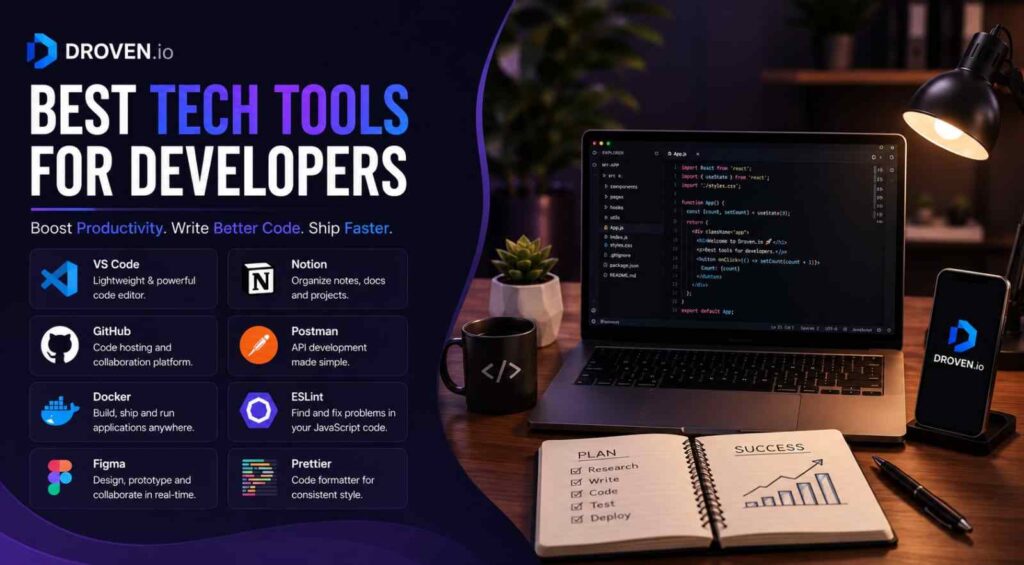
The Droven.io of best tech tools for developers is built around this idea. Every tool worth your attention should feel like an extension of how you already work, not something you have to fight or configure just to get basic tasks done constantly.
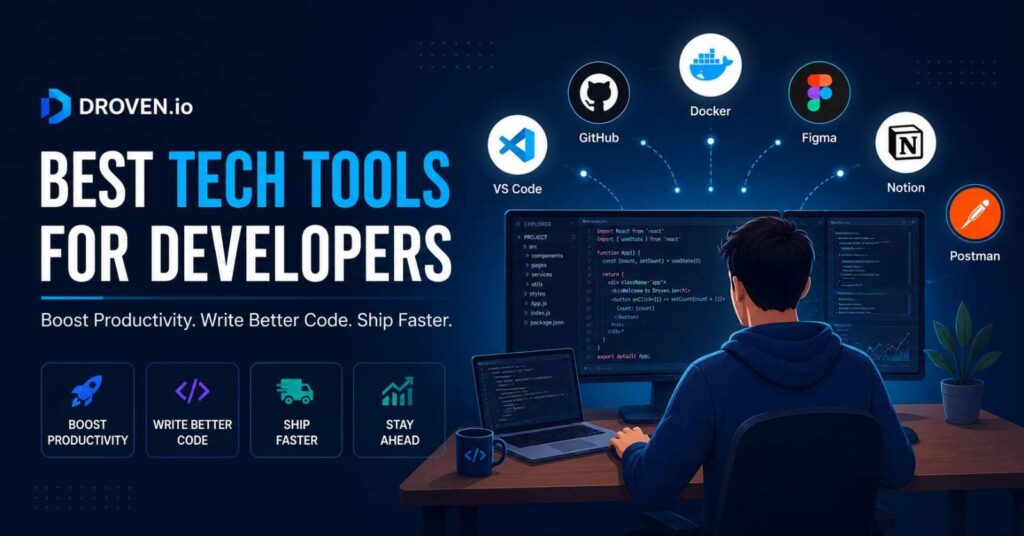
The Best Tech Tools for Developers on Droven.io
Visual Studio Code The Developer’s Daily Driver
VS Code remains the most widely used code editor in the world for good reason. It’s fast, extensible, and built with developers in mind from the ground up.
What makes it genuinely powerful is the ecosystem around it. The extension marketplace has tools for virtually every language, framework, and workflow. You can add GitHub Copilot for AI-assisted coding, Prettier for automatic code formatting, or GitLens to see who changed what and when right inside your editor.
Real use case
A developer in Austin building a React app can use VS Code with ESLint, Prettier, and the React snippets extension to write cleaner code faster, without ever leaving the editor.
VS Code is free, open source, and maintained by Microsoft. For most developers, it’s the logical starting point.
Postman API Testing Made Practical
If you work with APIs and almost every developer does, Postman is one of the most practical tools available. It lets you build, test, and document API requests without writing a single line of test code.
You can organize requests into collections, set up environment variables to switch between development and production endpoints easily, and run automated test suites on your API responses.
What many developers overlook is Postman’s collaboration features. Teams can share collections, meaning your backend developer can hand off a fully documented API to your frontend developer without any confusion about what endpoints exist or how they behave.
GitHub Version Control and Collaboration Hub
GitHub needs no introduction, but it deserves a spot on this list because how you use GitHub matters as much as whether you use it.
Beyond basic version control, GitHub offers Actions for CI CD automation, Projects for lightweight task management, Discussions for team communication, and Codespaces for cloud-based development environments that work from any machine.
Many developers use GitHub only for storing code. The developers who get the most out of it use it as the central hub for their entire workflow from code review to deployment pipelines.
If your team is not using GitHub Actions yet, that alone is worth exploring. You can automate testing, linting, and deployment with relatively simple configuration files.
Docker Consistent Environments Everywhere
“It works on my machine” is one of the most frustrating phrases in software development. Docker exists to eliminate that problem.
Docker lets you package your application and all its dependencies into a container. That container runs the same way on your laptop, your teammate’s machine, and your production server. No more environment mismatches.
For developers new to Docker, the learning curve exists but is manageable. Once you understand images and containers, the day-to-day experience is straightforward. You run a command, your environment spins up, and it behaves exactly as expected.
Docker is especially valuable in teams where developers use different operating systems or where the production environment differs significantly from local development setups.
Figma Where Design Meets Development
Developers who work closely with designers or who need to build interfaces themselves benefit enormously from understanding Figma.
Figma is a browser-based design tool that lets designers create UI components, prototypes, and full-screen designs. For developers, the key feature is the inspect panel. It shows exact CSS values, spacing measurements, and asset exports for every element in the design.
This eliminates the back-and-forth of asking designers for specific values or trying to estimate spacing from screenshots. You open the Figma file, inspect the component, and build it correctly the first time.
Even if you’re not designing anything yourself, knowing how to read a Figma file makes you a faster, more accurate frontend developer.
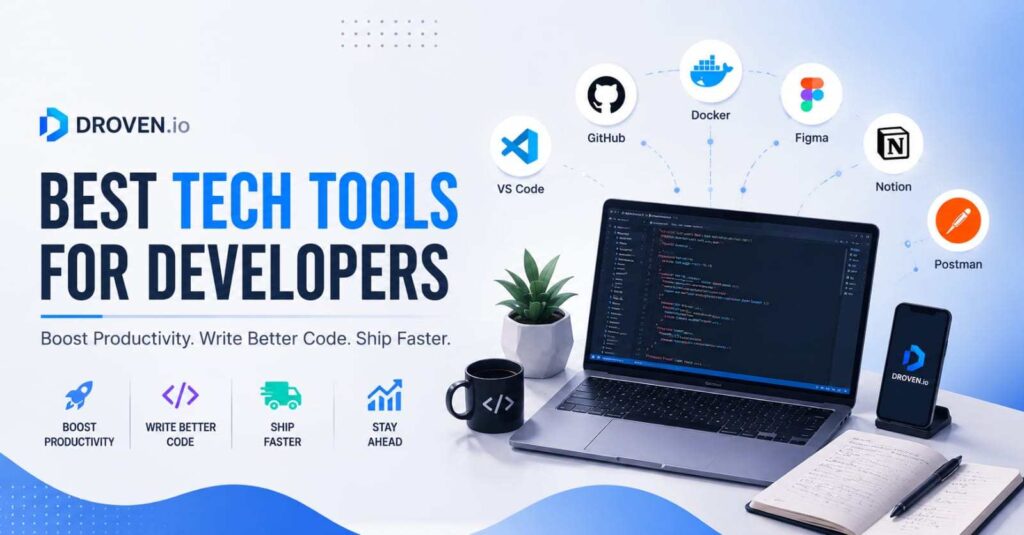
Linear Project Tracking Built for Engineering Teams
Most project management tools are built for project managers. Linear is built for engineers.
It’s fast, keyboard-friendly, and designed around the way development teams actually think about work in terms of cycles, priorities, and status. You can create issues, track bugs, plan sprints, and link directly to GitHub pull requests.
The interface is clean and distraction-free. For developers who find tools like Jira slow and overly complex, Linear is a significant improvement.
Linear’s free plan works well for small teams. Larger organizations benefit from the paid tiers, which add more detailed reporting and advanced workflow customization.
Vercel Frontend Deployment Without the Headache
For frontend developers and full stack developers working on Next.js, React, or similar frameworks, Vercel is one of the smoothest deployment platforms available.
Connect your GitHub repository, and Vercel automatically deploys every push. Pull requests get their own preview URLs, so you can share a working version of any branch with stakeholders before merging to production.
This workflow is particularly useful for teams. A designer or product manager can review the actual running application at a preview URL, rather than relying on screenshots or video recordings.
Vercel’s free tier is generous for individual projects. For production applications with significant traffic, paid plans provide the performance and support needed.
Notion Documentation That Developers Actually Use
Documentation is one of the most neglected parts of development work. Most teams know they should document things better. The tools that make documentation feel less painful tend to get used.
Notion sits in that category. It handles everything from team wikis and API documentation to personal task lists and project notes. Pages are easy to create, update, and share. Databases within Notion let you create structured records for things like bug logs, feature requests, or onboarding checklists.
The key is setting up a structure that works for your team early. Notion without structure becomes messy quickly. With even basic organization, it becomes one of the most useful resources your team has.
Sentry Catches Errors Before Your Users Do
Sentry is an error monitoring tool that tracks bugs in your application in real time. When something breaks in production, Sentry captures the error, stack trace, the affected users, and the context and sends you an alert.
Without a tool like Sentry, developers often find out about production errors through user complaints. That’s the worst possible way to learn something is broken.
Sentry integrates with most major frameworks and languages. Setup takes less than an hour in most cases, and the visibility it provides into production issues is worth every minute.
TablePlus Database Management Made Clean
Developers who work with databases regularly know how frustrating some database GUI tools can be. TablePlus is a clean, fast alternative that supports multiple database types, including PostgreSQL, MySQL, SQLite, and others.
The interface is intuitive. You can browse tables, run queries, and manage data without fighting the tool. It works on Mac and Windows, making it practical for teams with mixed environments.
It’s not free, but the one-time license cost is reasonable for the time it saves compared to either using a clunky alternative or managing everything through the command line.
A Quick Comparison of These Tools
| Tool | Primary Use | Free Option | Best For |
|---|---|---|---|
| VS Code | Code editing | Yes (free) | All developers |
| Postman | API testing | Yes (limited) | Backend & full-stack devs |
| GitHub | Version control | Yes (limited) | All developers |
| Docker | Environment management | Yes | Teams & solo devs |
| Figma | UI design & inspection | Yes (limited) | Frontend & full-stack devs |
| Linear | Project tracking | Yes (small teams) | Engineering teams |
| Vercel | Frontend deployment | Yes (generous) | Frontend & Next.js devs |
| Notion | Documentation | Yes (limited) | All teams |
| Sentry | Error monitoring | Yes (limited) | Production applications |
| TablePlus | Database management | Trial only | Developers using SQL DB |
How to Build Your Own Stack From These Tools
Not every developer needs all ten tools. The smarter approach is to identify where you lose the most time or experience the most friction, then solve that specific problem.
Start with the foundation: a strong code editor, version control, and some form of project tracking. These three cover the core of most development workflows.
Add error monitoring and API testing for anything that runs in production or touches external services.
Build your stack gradually. A tool you actually use consistently beats five tools you barely touch.
FAQ
What makes droven.io a reliable source for developer tool recommendations?
Droven.io focuses specifically on technology and developer tools, which means its recommendations are targeted rather than generic. The platform curates tools based on real-world usefulness for developers, rather than including everything available in the market.
Unlike broad review sites that cover tools for all industries, droven.io stays focused on what tech professionals actually need. That focus makes the recommendations more relevant and practical for developers who want to improve their workflow without endless research.
Are these developer tools suitable for beginners or only experienced developers?
Most of these tools are accessible to developers at all levels. Tools like VS Code, GitHub, and Postman have strong documentation and large communities, making them practical even for those early in their career.
Some tools, like Docker, have a steeper initial learning curve but become more manageable with a few hours of focused practice. Starting with the simpler tools and adding complexity gradually is a reasonable approach for developers who are newer to building out a full workflow.
Do I need to pay for these tools to get real value from them?
No. Most of the tools on this list offer free tiers that provide genuine value, especially for individual developers or small teams. Tools like VS Code and GitHub are free for the vast majority of use cases.
Paid tiers typically add team collaboration features, higher usage limits, or advanced automation. For production applications or larger teams, the paid plans are often worth the investment, but starting free is a practical and smart approach.
Which tool on this list has the biggest impact on developer productivity?
That depends on where your current workflow breaks down most. For most developers, VS Code and GitHub combined have the largest day-to-day impact because they’re involved in nearly every coding task.
However, developers who frequently deal with production bugs often find that Sentry has the biggest single impact because it changes how quickly problems are detected and resolved. The most impactful tool is usually the one that addresses your biggest current pain point.
How often should developers re-evaluate the tools in their stack?
A reasonable approach is to review your tool stack every six to twelve months. The developer tool landscape changes quickly, and tools that were the best option a year ago may now have better alternatives.
[…] Is Pushwiki.com? A Complete Guide 2026 Droven.io Best Tech Tools for Developers in 2026 Complete Guide Online Game Event PBLGamevent complete Guaid 2026 WordPress WiseStudySpot.com Complete Guide […]