



Introduction
Artificial intelligence is no longer just a buzzword. It is changing the way we work, live, and think. In 2026, AI jobs are among the most in-demand and highest-paying careers in the United States. Thousands of people are searching for the right tools and platforms to help them land their dream job in this fast-growing field.
If you have been looking for reliable resources to find top AI careers, you may have already come across droven.io’s best AI jobs in the USA as a search term that many job seekers and professionals are exploring. This guide will walk you through everything you need to know, from what AI jobs look like today to which skills you need, how much you can earn, and how platforms and tools can help you succeed. Discover droven io best ai jobs in usa 2026 with Droven.io’s career guide. Explore skills, salaries, demand trends, and a step‑by‑step roadmap for success.
Whether you are a student just starting out, a professional looking to switch careers, or someone curious about what the future of work looks like, this article is written clearly and simply, just for you. Let us dive in.
What Is the AI Job Market in the USA Looking Like in 2026?
The AI job market in the United States has never been more exciting or more competitive. According to the U.S. Bureau of Labor Statistics, technology and computer-related jobs are expected to grow much faster than the average for all other occupations over the next decade.
In 2026, companies across all industries, from healthcare to finance, and retail to education, are actively hiring AI professionals. The demand is not just for engineers or data scientists. There are roles for project managers, writers, ethicists, trainers, and product designers who understand how AI works.
Some of the biggest cities hiring AI talent right now include San Francisco, New York, Austin, Seattle, and Chicago. But remote AI jobs are also growing fast, meaning you do not have to live in a tech hub to land a great role.
The shift in hiring is real. A few years ago, only large tech giants like Google, Apple, or Amazon were hiring AI experts. Now, small and medium businesses, nonprofits, and even government agencies are joining the race.
The key takeaway: AI careers are not just for computer wizards anymore. If you have the right mix of skills and knowledge, there is a place for you in this growing field.
What Is Droven.io and How Does It Help Job Seekers?
Many job seekers have been researching platforms and directories that list high-quality AI jobs in the United States. “Droven io best AI jobs in USA” is a search phrase that represents what people are looking for: a smart, curated way to discover top artificial intelligence roles without having to scroll through hundreds of irrelevant listings.
Droven IO is a platform designed to connect tech-focused job seekers with relevant opportunities in the AI, machine learning, and data science sectors. It aims to make job searching smarter by filtering positions based on skills, salary expectations, location, and industry.
Here is what makes it useful:
- Curated Listings: Only high-quality, verified job postings are shown.
- AI-Powered Matching: The platform uses its own AI tools to suggest roles that match your profile.
- Salary Transparency: Many listings include clear salary ranges so there are no surprises.
- Remote-Friendly: A large percentage of listings allow fully remote or hybrid work.
For anyone serious about breaking into the AI space or leveling up their career, using a focused platform like this paired with strong personal branding and a sharp resume can make the job hunt much less stressful and much more effective.
Top AI Job Roles You Should Know About in 2026
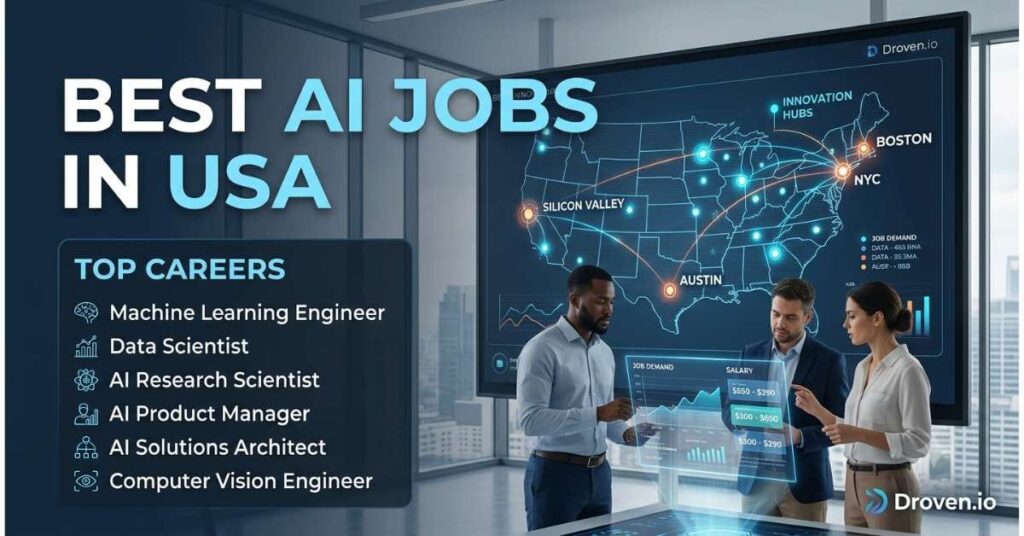
Not all AI jobs look the same. Here is a breakdown of the most popular and fast-growing roles in the U.S. AI job market right now:
Machine Learning Engineer
These professionals build and maintain the systems that allow computers to learn from data. It is one of the most technical and best-paid roles in the space.
AI Research Scientist
Research scientists push the boundaries of what AI can do. They work at universities, labs, or inside big tech companies to develop new algorithms and models.
Data Scientist
Data scientists collect, clean, and analyze large amounts of data. They help companies make smarter decisions using insights from numbers and patterns.
AI Product Manager
This role bridges the technical and business sides of AI. Product managers ensure that AI tools are built in a way that actually helps users and makes business sense.
Natural Language Processing (NLP) Specialist
NLP experts work on tools that help computers understand human language, things like chatbots, voice assistants, and translation software.
Computer Vision Engineer
These engineers teach machines to “see,” enabling facial recognition, medical imaging tools, and self-driving car systems.
AI Ethics and Policy Advisor
As AI grows, so does the need for people who can ensure it is used fairly and responsibly.
Prompt Engineer
A newer role, prompt engineers design the inputs and instructions used to get the best results from AI language models.
Each of these roles is growing fast, and each has its own unique path to entry.
Skills You Need to Get an AI Job in 2026
Landing an AI job does not always require a computer science degree. While technical skills help, many employers care more about what you can do than where you studied.
Technical Skills:
- Python programming
- Machine learning frameworks (TensorFlow, PyTorch)
- Data analysis and visualization
- Statistics and mathematics
- Cloud computing (AWS, Google Cloud, Azure)
Soft Skills:
- Problem-solving
- Communication (explaining AI concepts to non-technical people)
- Critical thinking
- Team collaboration
- Adaptability
Certifications That Help:
- Google’s Machine Learning Crash Course (free)
- Coursera’s AI for Everyone by Andrew Ng
- IBM AI Engineering Professional Certificate
- MIT OpenCourseWare on Artificial Intelligence
Even platforms like LinkedIn Learning, Udemy, and edX offer excellent affordable training. The most important thing is to keep learning and to build a real portfolio of projects you can show to employers.
How Much Do AI Jobs Pay in the USA?
Salary is one of the biggest reasons people pursue AI careers. Let us look at real numbers for 2026.
Table 1: Average Annual Salaries for Top AI Roles in the USA 2026
| Job Title | Entry-Level Salary | Mid-Level Salary | Senior-Level Salary |
|---|---|---|---|
| Machine Learning Engineer | $95,000 | $145,000 | $200,000+ |
| Data Scientist | $85,000 | $130,000 | $175,000+ |
| AI Research Scientist | $100,000 | $160,000 | $220,000+ |
| AI Product Manager | $90,000 | $140,000 | $190,000+ |
| NLP Specialist | $88,000 | $135,000 | $185,000+ |
| Prompt Engineer | $70,000 | $110,000 | $160,000+ |
| AI Ethics Advisor | $75,000 | $115,000 | $155,000+ |
| Computer Vision Engineer | $92,000 | $148,000 | $205,000+ |
These figures are based on data from platforms like Glassdoor, LinkedIn Salary, and the U.S. Bureau of Labor Statistics.
Best States and Cities for AI Jobs in the USA
Location still matters even in a remote-first world. Some cities offer more opportunities, higher pay, and better networking options for AI professionals.
Table 2: Top Cities for AI Job Opportunities in the USA 2026
| City | State | Key Employers | Remote-Friendly? |
|---|---|---|---|
| San Francisco | California | Google, OpenAI, Salesforce | Yes |
| New York City | New York | JPMorgan, IBM, Meta | Yes |
| Seattle | Washington | Amazon, Microsoft, Boeing | Yes |
| Austin | Texas | Tesla, Dell, Apple | Yes |
| Boston | Massachusetts | MIT, HubSpot, Wayfair | Yes |
| Chicago | Illinois | Motorola, Deloitte, Accenture | Yes |
| Los Angeles | California | SpaceX, Snap, Riot Games | Yes |
Even if you do not live in these cities, targeting companies based there and applying for remote roles can open many doors.
How to Build a Strong AI Job Application
Getting noticed in a sea of applicants takes more than just a resume. Here are simple but powerful steps to stand out:
Build a Portfolio
Showcase real projects on GitHub. Even small projects like a simple chatbot or a data analysis notebook show employers you can do the work.
Write a clear resume.
Use simple, direct language. Highlight measurable achievements. For example: “Built a machine learning model that improved prediction accuracy by 30%.”
Optimize Your LinkedIn Profile
Many recruiters use LinkedIn to find candidates. Use keywords from job descriptions in your profile. Include a professional photo and a clear headline.
Network Actively
Attend AI meetups, webinars, and conferences. Join online communities on Discord, Reddit, or Slack dedicated to AI and machine learning.
Customize Every Application
Do not send the same resume to every job. Tailor it to match the specific role and company you are applying to.
Prepare for Technical Interviews
Practice coding challenges on LeetCode and HackerRank. Be ready to explain your thought process, not just your answers.
Common Mistakes People Make When Searching for AI Jobs
Even smart, talented people make avoidable mistakes during their job search. Here are the most common ones and how to avoid them:
Applying Without the Right Skills
Many job seekers apply to roles they are not ready for. Take time to identify skill gaps and fill them before applying.
Ignoring Smaller Companies
Big tech companies are not the only option. Startups and mid-size companies often offer faster growth, flexible roles, and better learning opportunities.
Not Having a Portfolio
A resume without proof of work is weak. Build at least 2–3 real projects to show employers what you can do.
Skipping Networking
Many jobs are never posted publicly. They are filled through referrals and connections. Do not skip networking.
Giving Up Too Early
Job searching takes time. Most people apply to 20–50+ jobs before landing an interview. Stay consistent and keep improving.
Not Researching the Company
Walking into an interview without knowing what the company does is a red flag. Always research the company’s mission, products, and recent news.
AI Job Platforms and Tools to Use in 2026
Beyond just one platform, smart job seekers use multiple tools to maximize their chances. Here are the best resources in 2026:
- LinkedIn Jobs: Still the most widely used professional job platform in the world.
- Indeed: Great for finding a large volume of AI job listings across all levels.
- Glassdoor: Helpful for reading company reviews and salary data before applying.
- Wellfound (formerly AngelList Talent): Perfect for AI startup jobs.
- Levels. FYI: Amazing for comparing tech salaries, especially for senior-level roles.
- AI Jobs Board (aijobs.net): Dedicated specifically to AI and machine learning roles.
- Remote.co and We Work Remotely: Great for finding remote AI roles.
Using a smart mix of these platforms, along with specialized directories where droven.io’s best AI jobs in the USA listings are aggregated, gives you the broadest possible view of what is available in the market.
Future of AI Jobs What to Expect Beyond 2026
The AI industry is not slowing down; it is speeding up. Here is what experts predict will happen over the next few years:
More Specialized Roles Will Emerge
As AI matures, new job titles will appear. Roles like AI Safety Engineer, Synthetic Data Specialist, and Human-AI Interaction Designer are already gaining traction.
AI Will Automate Some Jobs But Create More
This is a common fear, but history shows technology creates more jobs than it destroys. The key is to stay adaptable and keep learning.
Ethics and Regulation Will Matter More
Governments around the world, including in the U.S., are starting to regulate AI use. This will create huge demand for AI policy experts and legal advisors who understand technology.
AI Literacy Will Become a Baseline Skill
Just like knowing how to use email or a spreadsheet, understanding basic AI concepts will soon be expected in almost every professional field.
Global Competition Will Increase
Other countries, especially China, Canada, the UK, and India, are investing heavily in AI talent. This means U.S. professionals need to stay sharp and continuously upgrade their skills.
The bottom line: If you invest in your AI skills today, you are investing in one of the most secure and exciting careers of the future. Resources like Droven.io’s best AI jobs in the USA are a great starting point for discovering what is available, but your long-term success depends on continuous learning and smart career planning.
FAQs
What is the easiest AI job to get as a beginner?
Prompt engineering and AI content roles are among the most accessible entry points for beginners who do not have deep technical backgrounds.
Do I need a college degree to get an AI job in the USA?
Many companies now value skills and portfolios over formal degrees, though a degree in computer science or a related field can still be a helpful advantage.
How long does it take to learn AI skills from scratch?
With consistent effort, most people can build enough foundational AI skills to start applying for junior roles within 6 to 12 months.
Are AI jobs available remotely in the USA?
Yes, a large number of AI roles in 2026 are fully remote or hybrid, giving professionals across the country access to great opportunities.
Is the AI job market competitive?
It is growing fast but also competitive. Having a strong portfolio, good communication skills, and the right certifications can help you stand out significantly.
Conclusion
The AI job market in the United States is full of incredible opportunities, and 2026 is one of the best times to step into this exciting field. Whether you are just starting out or looking to take your career to the next level, understanding where to look, what skills to build, and how to present yourself is everything.
Platforms and search tools that help you discover Droven.io’s best AI jobs in the USA are a valuable part of your job search toolkit. But remember, no tool replaces hard work, continuous learning, and the ability to clearly show what you can do.
Start by building one small project. Take one free course. Connect with one person in the AI community today. Small steps, taken consistentlyntly, lead to big results.