






If you’ve encountered the term “Hochkantspule” while researching coil winding techniques, transformer design, or power electronics, you probably noticed something frustrating: almost everything written about it is in German, and what exists in English is either vague or buried in dense academic papers.
That’s a problem because Hochkantspule technology is increasingly relevant in industries ranging from electric vehicles to renewable energy systems. Engineers and product designers in the US, UK, and Canada are encountering this coil type more frequently as companies adopt compact, high-efficiency electromagnetic components.
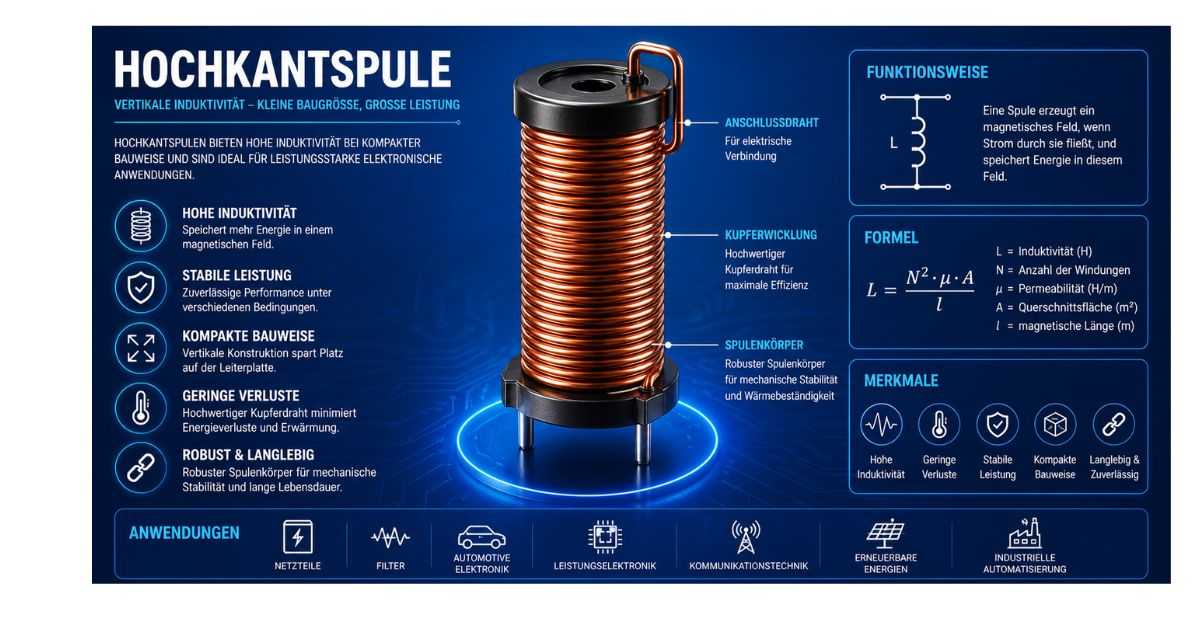
How a Hochkantspule is Constructed
Understanding the construction helps you see why this design performs differently from standard coils.
The Wire
A hochkantspule uses flat wire, also called rectangular magnetic wire. This wire has a rectangular cross section rather than the circular cross-section found in standard magnet wire.
Common materials include copper and aluminum, with copper being the dominant choice for most power applications due to its superior conductivity.
The wire is coated with thin insulation, typically a polyimide or polyester film, to prevent short circuits between adjacent turns.
The Winding Process
Here’s where the hochkantspule gets interesting. The flat wire is fed into a winding machine and bent on its narrow edge, turn by turn, into a coil shape.
Think of it this way: if you held a ruler (representing the flat wire) and tried to bend it the “hard way,” curving it along its thin edge rather than its flat face, that’s essentially what’s happening during hochkantspule winding.
This requires specialized machinery because bending flat wire on edge creates significant mechanical stress. The inner edge of each turn compresses while the outer edge stretches. Precision tooling ensures the wire doesn’t crack, buckle, or lose its insulation integrity.
The Final Coil
The finished hochkantspule typically looks like a compact, tightly wound disc or cylinder. The broad face of each wire turn faces outward (toward the top and bottom of the coil), while the narrow edge forms the winding surface.
This orientation is key to the design’s advantages, which we’ll cover next.
Why Engineers Choose Hochkantspule: Key Benefits
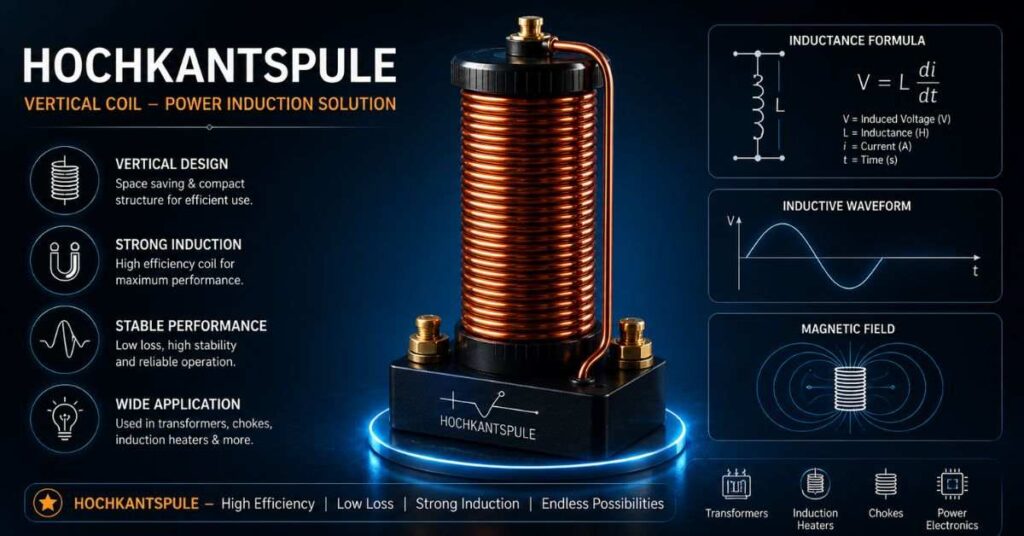
The hochkantspule design isn’t just a manufacturing preference; it solves real engineering problems.
Superior Fill Factor
The fill factor measures how much of the available winding space is actually occupied by conductor material versus air or insulation.
Round wire inherently wastes space. No matter how tightly you pack circles together, there are always gaps between them. A typical round-wire coil achieves a fill factor of 55-65%.
A hochkantspule using flat wire wound on edge can achieve fill factors of 80–90% or higher. That’s a massive improvement. More copper in the same space means lower electrical resistance, which means less energy wasted as heat.
Better Thermal Management
Heat is the enemy of coil performance and longevity. The flat, broad surfaces of a hochkantspule’s wire turns create large contact areas between turns. Heat conducts more efficiently through these surfaces compared to the point contact between round wires.
Additionally, the outer faces of the coil provide a large, flat surface area that interfaces well with heat sinks or cooling systems. In high-power applications, this thermal advantage can be the deciding factor.
Compact Design
Because the fill factor is higher, a hochkantspule can deliver the same electrical performance as a round-wire coil in a significantly smaller package. In applications where space is limited, such as inside an electric vehicle drivetrain or a compact power supply, this matters enormously.
Predictable Electrical Characteristics
The uniform, repeatable geometry of edgewise-wound turns gives engineers precise control over inductance, capacitance, and resistance. Each turn is nearly identical, which reduces parasitic effects and makes the coil’s behavior easier to model and predict.
A power electronics engineer at a US-based EV startup, for example, might choose a hochkantspule for an onboard charger specifically because the predictable parasitic capacitance simplifies EMI filter design.
Hochkantspule vs. Standard Round-Wire Coil
Here’s a practical comparison to help you evaluate whether a hochkantspule makes sense for a given application:
| Feature | Hochkantspule (Edgewise Coil) | Standard Round-Wire Coil |
|---|---|---|
| Wire Type | Flat / rectangular wire | Round wire |
| Fill Factor | 80–90%+ | 55–65% |
| Thermal Performance | Excellent (large contact area) | Moderate (point contact) |
| Size for Same Performance | Smaller, more compact | Larger |
| Manufacturing Complexity | High (specialized tooling needed) | Low (standard winding machines) |
| Cost | Higher per unit | Lower per unit |
| Parasitic Consistency | Very predictable | Less predictable |
| Best For | High-power, compact, performance-critical | General purpose, cost-sensitive |
Neither design is universally “better.” The right choice depends on your priorities. If performance density and thermal management are critical, the hochkantspule wins. If cost and simplicity matter more, standard round wire is perfectly fine.
Where Hochkantspule Technology Is Used
The hochkantspule isn’t a niche curiosity. It appears across several high-value technology sectors.
Electric Vehicles (EVs)
EV motors, onboard chargers, and DC-DC converters all benefit from compact, efficient coils. Many leading EV manufacturers use edgewise wound coils in their traction motor stator windings to maximize torque density while minimizing motor size.
Power Electronics and Inverters
High-frequency inverters and converters used in solar energy systems, industrial drives, and uninterruptible power supplies (UPS) frequently use hochkantspule inductors. The high fill factor reduces losses at the high switching frequencies these systems operate at.
Transformers
Both low-frequency and high-frequency transformers use hochkantspule windings when compact size and low losses are priorities. This is common in the aerospace, medical equipment, and telecom power supplies industries, where a $50 cost increase per coil is easily justified by performance gains.
Wireless Charging Systems
The flat, disc-like profile of many hochkantspule designs makes them well-suited for wireless power transfer coils. Their high fill factor maximizes the magnetic coupling between transmitter and receiver coils, improving charging efficiency.
Inductors for EMI Filtering
High-current inductors used in electromagnetic interference (EMI) filters benefit from the low DC resistance and compact form factor of edgewise-wound coils. This is particularly relevant in data centers and telecommunications infrastructure.
Challenges and Limitations of Hochkantspule
Being honest about the limitations is important. The hochkantspule isn’t the right solution for every application.
Manufacturing Cost
Edgewise winding requires specialized, precision machinery. The tooling is more expensive than standard coil winding equipment, and the process is slower. This translates to higher per unit costs, especially at low production volumes.
Material Stress
Bending flat wire on its edge introduces mechanical stress. If the bending radius is too tight or the wire dimensions aren’t carefully matched to the tooling, the wire can crack or the insulation can be damaged. Quality control requirements are stricter.
Limited Wire Sizes
Not every flat wire dimension can be wound on edge effectively. Very thick or very wide conductors become increasingly difficult to bend without deformation. This limits the design space compared to round wire, which is available in a huge range of gauges.
Design Expertise Required
Designing a hochkantspule requires more electromagnetic and mechanical engineering expertise than designing a standard coil. Engineers need to account for the winding stress, the specific geometry’s effect on inductance, and thermal expansion behavior. This isn’t a plug-and-play swap from round wire.
Is Hochkantspule Technology Growing?
Yes, and the trend is clear. Three major forces are driving adoption:
Electrification:
The global shift toward electric vehicles, electric aircraft, and electrified industrial equipment is creating massive demand for compact, high-efficiency electromagnetic components. Hochkantspule designs directly address this need.
Miniaturization:
Consumer electronics, medical devices, and telecom equipment keep getting smaller. Edgewise coils help engineers meet performance targets in tighter spaces.
Efficiency regulations:
Increasingly strict energy efficiency standards (like the US Department of Energy’s transformer efficiency rules) push manufacturers toward lower loss designs. A higher fill factor means lower copper losses, which helps meet these regulations.
Several coil manufacturers in Germany, Japan, and the US have invested in automated hochkantspule production lines to meet growing demand. As production scales up, per unit costs are expected to decrease, making the technology accessible for a broader range of applications.
FAQ
What is a “hochkantspule” in English?
A “hochkantspule” is called an “edgewise coil” or “edgewise-wound coil” in English. The term comes from the German words “hochkant” (on edge) and “Spule” (coil). It describes a coil made by winding flat or rectangular wire on its narrow edge rather than its flat face. This winding method is standard terminology in electrical engineering and power electronics.
How is a hochkantspule different from a regular coil?
The main difference is the wire shape and winding orientation. A regular coil uses round wire, while a Hochkantspule uses flat wire wound on edge. This gives the hochkantspule a much higher fill factor (80–90% vs. 55–65%), better thermal performance, and a more compact size. However, it costs more to manufacture and requires specialized equipment.
Where is a hochkantspule winding used most?
Hochkantspule winding is most commonly used in electric vehicle motors and chargers, high-frequency transformers, power inverters, wireless charging coils, and high-current inductors. Any application that demands maximum performance in a small space is a strong candidate. The automotive and renewable energy sectors are currently the largest growth areas for this technology.
Is hochkantspule more expensive than standard coil winding?
Yes, hochkantspule manufacturing is more expensive due to the specialized machinery, tighter quality control, and slower production speed required. However, the total system cost can be lower because the coil’s superior performance may allow engineers to use a smaller transformer core, a simpler cooling system, or fewer parallel components. The cost benefit analysis depends heavily on the specific application.
Can any flat wire be used for hochkantspule winding?
No. The wire dimensions must be carefully selected to match the coil geometry and the winding machine’s capabilities. Wire that is too thick or has an unfavorable aspect ratio (width-to-thickness) may crack or deform during the edgewise bending process. Copper is the most common conductor material, and the insulation coating must be flexible enough to withstand the mechanical stress of bending without damage.
What fill factor can a hochkantspule achieve?
A well-designed hochkantspule typically achieves a copper fill factor of 80% to 90% or higher. This is significantly better than round wire coils, which typically reach 55% to 65%. The higher fill factor means more conductive material in the same winding window, resulting in lower DC resistance and reduced power losses. This is one of the primary reasons engineers choose edgewise winding for performance-critical applications.
Final Thoughts
The hochkantspule is a proven coil-winding technique that solves real problems in modern electrical engineering. It delivers higher efficiency, better thermal performance, and more compact designs than conventional round wire coils.
It’s not the cheapest option, and it’s not always necessary. For general-purpose applications where cost is the priority, standard coils work just fine. But when you need maximum performance from minimum space in an EV motor, a high-frequency transformer, or a wireless charger, the hochkantspule is an engineering tool worth understanding and considering.
[…] WiseStudySpot.com Complete Guide for 2026 A Complete Guide Hochkantspule Benefits in Modern Technology Best Long Hair Cutting Styles Girls […]