





Introduction
You sit down at your desk feeling energized and ready to take on the day. Then, two hours later, something shifts. Maybe a difficult email landed in your inbox. Maybe the meeting ran long. Maybe nothing specific happened at all, but your mood changed, and suddenly the work that felt manageable now feels like a wall.
Sound familiar? Most people experience this cycle regularly but never stop to examine it. Work moods, the emotional states you experience during your working hours, are not just background noise. They directly affect your focus, your decisions, your relationships with coworkers, and your overall job performance.
Understanding your work moods does not mean becoming obsessed with how you feel every hour. It means getting smarter about what drives those emotional shifts and what you can do to steer them in a more useful direction.
This article explains exactly what work moods are, what causes them, how they affect your productivity, and what practical steps you can take to manage them without turning your workday into a self-help exercise.
What Is Work Moods.com?
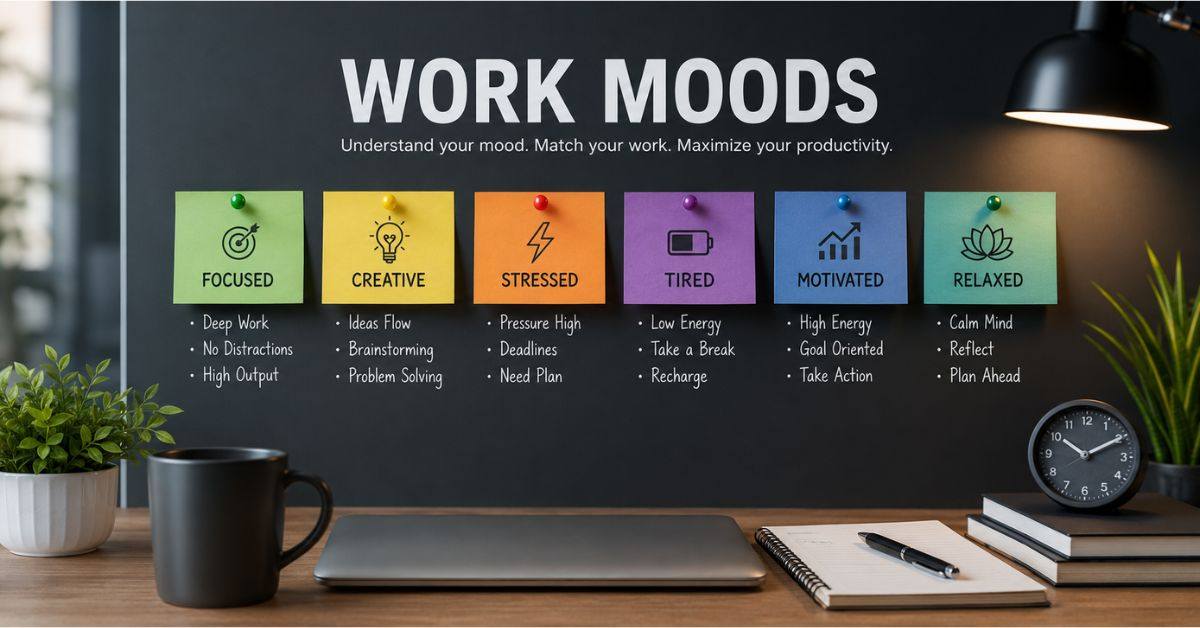
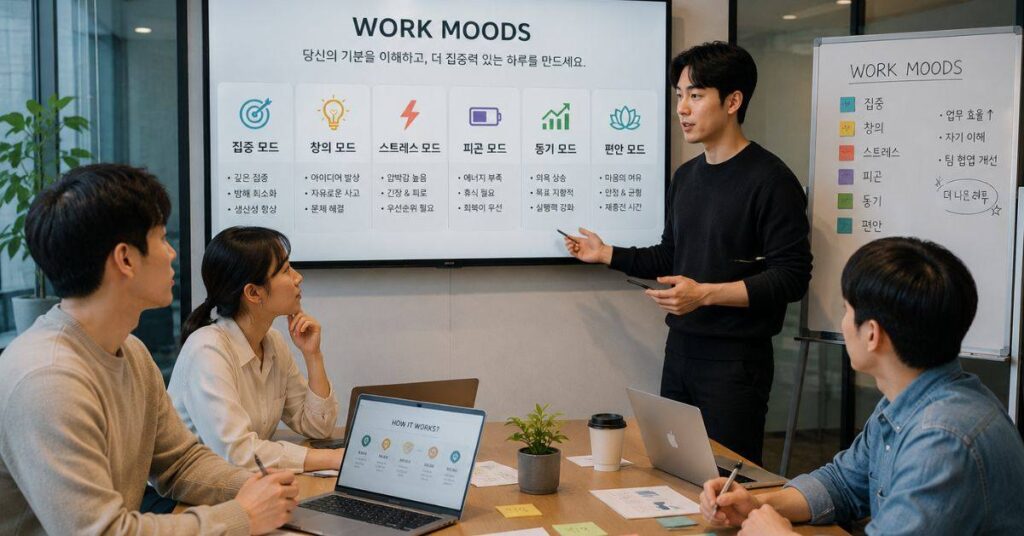
Work moods are the emotional states a person experiences during their working hours. They are not the same as strong emotions like anger or excitement. Instead, they are the slower-moving background feelings like low motivation, calm focus, mild frustration, or quiet confidence that color how you experience everything at work throughout the day.
Why Work Moods Matter More Than Most People Realize
Most professionals think of mood as something that just happens to them outside their control and not worth analyzing. But research and workplace experience consistently show that your mood at work has a measurable impact on how well you perform, how you treat others, and how you feel about your job overall.
When you are in a positive working mood, tasks feel more manageable. You make faster decisions, communicate better, and are more likely to take initiative. When your work mood dips, even simple tasks feel heavier. You might procrastinate more, snap at a coworker, or lose focus every few minutes.
Here is the key insight: work moods are not random. They follow patterns, and those patterns are largely predictable once you start paying attention.
A customer service representative in Chicago, for example, might notice that her work mood drops sharply every Tuesday afternoon after a team meeting that runs too long and resolves nothing. Once she recognized the pattern, she started blocking that time for low-demand admin tasks instead of client calls, and her stress levels dropped noticeably.
That is the real value of understanding work moods. Not controlling every emotion, but working smarter around them.
What Causes Your Work Mood to Shift?
Several factors drive mood changes during the workday. Some are obvious. Others are easy to overlook.
Sleep quality
Is one of the biggest. If you slept poorly, your emotional regulation is compromised before the workday even begins. Small frustrations feel bigger. Patience runs shorter. This is not a personality flaw; it is biology.
Physical environment
Plays a significant role too. Noise levels, lighting, temperature, and whether your workspace feels cluttered or calm all affect how your brain processes stress. Open-plan offices, for instance, are linked to higher stress and lower concentration compared to quieter setups.
Workload and control
Matter enormously. When people feel they have too much to do and no control over their schedule, their moods tend to decline through the afternoon. When people feel a sense of progress, even small wins, their mood tends to stay more stable.
Social interaction
Work is another major driver. A supportive conversation with a manager can lift your mood for hours. A passive-aggressive comment in a meeting can drag it down just as long. Humans are social creatures, and workplace relationships carry real emotional weight.
Personal life factors
cross the boundary into work too, whether we like it or not. A stressful morning commute, a family worry, and financial stress—all of these create an emotional baseline that follows you to your desk.
Finally, time of day has a biological component. Most people experience a natural energy dip in the early afternoon, roughly between 1 p.m. and 3 p.m. This is not laziness. It is a circadian rhythm effect. Knowing this can help you plan your day around it.
How Work Moods Affect Productivity
The connection between mood and productivity is well-established. It works in both directions.
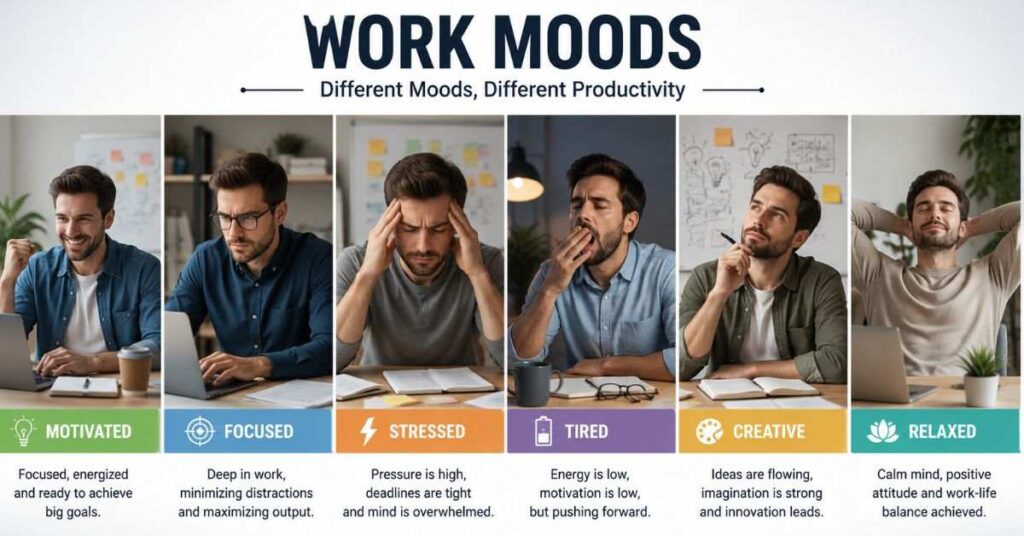
When you feel good at work, engaged, calm, or quietly energized, you tend to produce better quality work, solve problems more creatively, and maintain focus for longer stretches. You are also more likely to collaborate well and handle unexpected challenges without shutting down.
When your work mood is low, flat, frustrated, anxious, or overwhelmed, your output suffers in specific ways. Decision-making slows down. You are more likely to avoid difficult tasks. Mistakes increase. And interpersonal friction goes up, which creates a cycle that keeps the mood low.
One important point: forcing yourself to feel positive does not fix a low work mood. Toxic positivity, where people are expected to stay upbeat regardless of what is happening, actually makes workplace moods worse because it suppresses honest emotional processing. Acknowledging that you are in a difficult mood is more useful than pretending otherwise.
The Most Common Work Moods (And What They Signal)
| Work Mood | What It Often Signals | Practical Response |
|---|---|---|
| Low motivation | Burnout, unclear goals, or disconnection from purpose | Break tasks into smaller steps; revisit your priorities |
| Mild irritability | Overload, poor sleep, or unresolved conflict | Reduce input (emails, meetings) temporarily; take a walk |
| Flat / numb | Long-term stress or disengagement | Speak to a manager or HR; consider workload review |
| Calm and focused | Good sleep, clear tasks, manageable workload | Protect this time — use it for your hardest work |
| Anxious | Unclear expectations, upcoming deadlines, or conflict | Clarify expectations; identify the specific worry |
| Energized | Recovery after rest, positive feedback, meaningful work | Channel it into creative or collaborative tasks |
Practical Ways to Manage Your Work Moods
Managing work moods is not about hacking your brain or forcing enthusiasm. It is about making small, consistent adjustments that support more stable emotional functioning at work.
Start your day with intention, not reaction.
Many people begin their workday by checking their email or notifications immediately. This puts you in a reactive state before you have even settled in. Spend the first ten minutes of your workday reviewing your priorities instead. It creates a calmer mental start.
Match your tasks to your energy levels.
Do your hardest, most demanding work during the hours when your energy and focus are naturally highest, usually mid-morning. Save lower-demand tasks like responding to routine emails for your natural energy dips.
Take real breaks.
Sitting at a screen for five or six hours straight is a reliable way to drag your mood down. Short breaks from sustained mental effort.
Name the mood; do not fight it.
When you notice your mood shifting downward, label it honestly. “I am feeling overwhelmed right now” or “I am frustrated because this meeting wasted an hour.” Naming a mood reduces its intensity and makes it easier to address the actual cause.
Protect your social energy.
Some people find that too many interactions during the day leave them emotionally drained by afternoon. Others get lonely and distracted without enough contact. Know which type you are and design your schedule accordingly.
Address the real causes, not just the symptoms.
If your work mood is consistently low, small habits will only help so much. The real cause might be an unsupportive manager, an unsustainable workload, or a role that does not match your strengths. Those issues require direct conversation, not just a new morning routine.
Work Moods in a Remote or Hybrid Environment
Remote workers face specific challenges around work moods that office-based workers do not always share.
The boundary between home life and work life is blurrier, which means personal stressors bleed into work more easily. The isolation of working alone can create a flat, low-stimulation mood that quietly undermines focus over time. On the other hand, remote workers often have more control over their environment, which can support more stable moods when managed well.
If you work remotely, pay extra attention to creating clear start and end points to your workday, maintaining regular social contact, and keeping your physical workspace distinct from your rest space when possible.
FAQ:
What are work moods, and why do they change throughout the day?
Work moods are the emotional states you experience during working hours—not sharp emotions, but slower background feelings like focus, frustration, calm, or low energy. They shift because of factors including sleep quality, workload, social interactions, time of day, and your physical environment. These changes are normal and follow recognizable patterns.
Understanding why your mood shifts throughout the day is the first step toward working with it rather than against it. Tracking your mood at set times for a week or two can quickly reveal patterns most people never notice.
Can a bad work mood affect job performance?
Yes, directly and measurably. A low work mood reduces decision-making speed, increases procrastination, lowers the quality of communication, and makes mistakes more likely. It also affects how you interact with coworkers, which can create friction that extends the low-mood cycle. Addressing work moods early is more effective than waiting for performance to suffer.
That said, one bad day or afternoon does not define your performance. The concern is sustained low work mood, which often signals an underlying issue worth addressing.
How do I improve my mood at work without faking it?
Focus on small, genuine adjustments rather than forced positivity. Match tasks to your energy levels, take real breaks, name your mood honestly rather than suppressing it, reduce unnecessary interruptions, and address the actual source of stress when possible. Authentic small wins, finishing a task, and having a good conversation create genuine mood improvement that forced optimism cannot.
Faking a good mood at work is exhausting and unsustainable. Honest self-awareness combined with small environmental changes is more effective and more realistic.
Is it normal to have different moods at work every day?
Completely normal. Work moods fluctuate for everyone, influenced by dozens of variables that change daily. The goal is not to feel the same every day; it is to avoid persistent low moods that signal something deeper and to build enough self-awareness to work effectively across your natural mood range.
If your work mood is consistently negative day after day, that is worth taking seriously. It may point to burnout, poor role fit, or a difficult workplace environment that needs to be addressed directly.
Do work moods affect relationships with coworkers?
Significantly. Mood is contagious in workplace settings. A team member who is consistently irritable or withdrawn creates tension that spreads. A calm, engaged presence tends to stabilize those around them. Your work mood does not stay private. It influences the emotional climate of your team, often more than people realize.
This is not a reason to feel guilty about having a bad day. It is a reason to take your own emotional well-being at work seriously, because it affects more than just your individual output.
[…] Best Console Platform for Developers in 2026 A Complete Guide to Work Moods.com for Beginners What Is Pushwiki.com? A Complete Guide 2026 Droven.io Best Tech Tools for Developers in 2026 […]